
Recognising & managing anaphylaxis
A UK pharmacy guide to recognising anaphylaxis, IM adrenaline doses, ABCDE treatment, refractory reactions, discharge safety and OSCE technique.
Anaphylaxis is a rapidly developing, potentially life-threatening systemic hypersensitivity reaction. The diagnosis is clinical and treatment must not wait for a rash, blood test or perfect certainty. The action most likely to save life is early intramuscular adrenaline into the anterolateral thigh.
This guide reflects the Resuscitation Council UK 2025 special-circumstances guidance, its detailed healthcare-provider anaphylaxis guideline, and NICE NG258 on assessment and referral after emergency treatment.
The emergency answer in eight steps
- Recognise sudden Airway, Breathing or Circulation compromise, with or without skin or mucosal changes.
- Call for emergency help and stop the trigger if this can be done immediately.
- Give IM adrenaline without delay into the anterolateral thigh.
- Position safely: usually lie flat with legs raised; adapt for severe breathing difficulty or pregnancy, and do not allow sudden standing.
- Use an ABCDE approach, give high-concentration oxygen when indicated and attach monitoring.
- Give an IV crystalloid bolus early for shock and reassess the response.
- Repeat IM adrenaline after 5 minutes if Airway, Breathing or Circulation problems persist.
- If problems continue after two appropriate IM doses, treat as refractory anaphylaxis and obtain expert critical-care support for an adrenaline infusion.
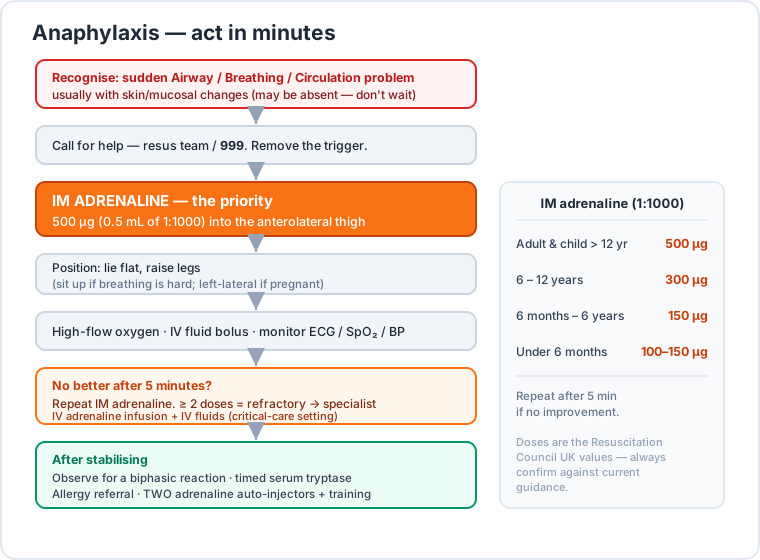
Skin changes support the diagnosis but are neither necessary nor sufficient. Urticaria alone is not anaphylaxis; life-threatening bronchospasm or shock after an allergen may be anaphylaxis even with no rash.
How to recognise anaphylaxis
Look for sudden onset and rapid progression, usually over minutes, involving one or more of the following.
Airway
- tongue or throat swelling
- hoarse voice or difficulty speaking
- difficulty swallowing
- stridor
- a sensation of throat closing
Breathing
- wheeze or severe bronchospasm
- rapid breathing, increased work of breathing or fatigue
- hypoxaemia or cyanosis
- confusion caused by hypoxia
- respiratory arrest
Circulation
- pale, clammy appearance
- tachycardia
- hypotension, faintness or collapse
- reduced consciousness
- cardiac arrest
Skin and mucosa
- generalised flushing
- urticaria
- angioedema
Skin or mucosal signs may be absent in a clinically important minority of reactions. Conversely, isolated urticaria, rhinitis or facial swelling without Airway, Breathing or Circulation compromise is usually an allergic reaction rather than anaphylaxis.
Common triggers include food, medicines, insect venom and latex. An obvious trigger supports the diagnosis, but its absence does not exclude anaphylaxis.
Important differentials
Use ABCDE and treat life-threatening findings while considering:
| Differential | Helpful clues | Safety point |
|---|---|---|
| Severe asthma | Prominent wheeze and known asthma; skin signs may be absent in both conditions | If allergen exposure and sudden deterioration make anaphylaxis plausible, give IM adrenaline |
| Vasovagal episode | Bradycardia, pallor and rapid improvement when flat | Persistent hypotension or respiratory features should prompt reconsideration |
| Panic or hyperventilation | Tingling, carpopedal spasm, no objective Airway/Breathing/Circulation compromise | Do not dismiss objective wheeze, hypoxia or hypotension as anxiety |
| ACE-inhibitor angioedema | Tongue or airway swelling, often without urticaria | It may respond poorly to adrenaline but still requires urgent airway management |
| Inducible laryngeal obstruction | Inspiratory symptoms and variable upper-airway noise | Seek expert assessment; do not delay adrenaline when the diagnosis is uncertain and anaphylaxis is plausible |
Adrenaline: dose, route and concentration
For healthcare-provider treatment, use adrenaline 1 mg/mL solution, historically called 1:1000, by intramuscular injection into the anterolateral thigh.
| Age | IM dose of adrenaline 1 mg/mL | Volume |
|---|---|---|
| Adult and child over 12 years | 500 micrograms | 0.5 mL |
| Child 6–12 years | 300 micrograms | 0.3 mL |
| Child 6 months–6 years | 150 micrograms | 0.15 mL |
| Infant under 6 months | 100–150 micrograms | 0.10–0.15 mL |
Repeat the age-appropriate IM dose after 5 minutes if Airway, Breathing or Circulation compromise persists.
The IM route is preferred because it is rapid, practical and substantially safer than an IV bolus. IV adrenaline for anaphylaxis should be used only by experienced specialists in an appropriate monitored setting. A dosing error or rapid IV bolus can cause severe hypertension, arrhythmia or myocardial ischaemia.
Do not underdose an adult because an auto-injector strength is more familiar. Healthcare-provider ampoule dosing and community auto-injector dosing are related but not interchangeable.
Positioning can be life-saving
A patient with anaphylaxis should not stand or walk suddenly, even if they feel better, because reduced venous return can precipitate cardiovascular collapse.
- Usually lay the person flat and raise the legs.
- If breathing is severely difficult, allow them to sit up gently with legs extended; return towards a lying position as soon as tolerated.
- In pregnancy, use the left lateral position to reduce aortocaval compression.
- An unconscious breathing patient may need a recovery position while the airway is managed.
- A distressed child can be positioned comfortably with a carer, while avoiding sudden upright movement.
The MHRA gives the same core advice for people using an adrenaline auto-injector: inject without delay, call 999, lie down, and use the second device after 5 minutes if not improving.
ABCDE management after the first adrenaline dose
Airway
Call for senior airway help early if there is stridor, progressive tongue swelling, voice change or exhaustion. Airway oedema can progress quickly, and intubation becomes harder as swelling worsens.
Breathing
Give high-concentration oxygen when clinically indicated and monitor oxygen saturation. Treat severe bronchospasm with inhaled bronchodilator as an adjunct, but never substitute salbutamol for adrenaline when anaphylaxis is causing Airway, Breathing or Circulation compromise.
Circulation
Obtain IV or intraosseous access without delaying adrenaline. Give an IV crystalloid bolus early for hypotension or shock and reassess pulse, blood pressure, perfusion and lung findings. Adults may require 500–1000 mL initially; children require weight-based fluid. Further fluid is guided by response and clinical context.
Disability and exposure
Assess consciousness and glucose where relevant. Expose enough to identify rash, swelling, infusion sites or an insect sting while preserving dignity and temperature.
Attach ECG, pulse oximetry and frequent non-invasive blood-pressure monitoring as soon as practical.
Refractory anaphylaxis
Refractory anaphylaxis means ongoing respiratory or cardiovascular compromise despite two appropriate doses of IM adrenaline.
Actions include:
- call for critical-care or anaesthetic help
- confirm that adrenaline was given into the correct site at the correct dose
- continue ABCDE, oxygen, monitoring and IV fluid resuscitation
- remove any continuing trigger, such as stopping an IV medicine
- start an IV adrenaline infusion under an experienced specialist using a local protocol
- consider additional measures for special circumstances, such as glucagon in a patient taking a beta-blocker, with expert guidance
Repeated IV adrenaline boluses by an inexperienced clinician are not the solution.
Antihistamines and corticosteroids
Antihistamines do not treat life-threatening Airway, Breathing or Circulation problems and must never delay adrenaline. Once the patient is stabilising, a non-sedating antihistamine may help persistent skin symptoms.
Routine corticosteroids are no longer advised for the acute treatment of anaphylaxis. They act too slowly to treat immediate compromise and have not been shown to prevent biphasic reactions. A corticosteroid may still be appropriate for a separate indication, such as a significant concomitant asthma exacerbation, but it is not a substitute for adrenaline.
This is a common OSCE discriminator: “adrenaline first” is not enough if the student then prioritises chlorphenamine and hydrocortisone before reassessing ABC.
Mast-cell tryptase
Tryptase can support later investigation, particularly in adults or when the trigger is drug related, venom related or unclear. It is not an acute rule-out test and a normal result does not exclude anaphylaxis.
- Record the time symptoms began.
- Take the first sample as soon as feasible after treatment has started.
- Take a second sample ideally 1–2 hours after onset and no later than 4 hours.
- A later baseline sample may be arranged after recovery or by the allergy service.
Never delay adrenaline, airway care or transfer to obtain a blood sample.
Observation and biphasic reactions
Symptoms can recur without further allergen exposure. Observation is therefore risk stratified under current NICE guidance and local policy.
Longer observation or admission is more likely when:
- two or more adrenaline doses were needed
- the reaction was severe or protracted
- there is severe asthma or respiratory compromise
- the trigger may continue to be absorbed
- the patient is remote from emergency care
- there are safeguarding, communication or self-management concerns
- the reaction occurred late in the day or follow-up cannot be secured
Children and young people require age-appropriate paediatric assessment. Do not quote one observation duration for every patient without checking NICE NG258 and local policy.
Discharge is part of treatment
Before discharge after suspected anaphylaxis:
- document the clinical features, timing and suspected trigger
- explain anaphylaxis and the possibility of recurrence
- provide clear instructions to use adrenaline and call 999 if symptoms recur
- prescribe two appropriate adrenaline auto-injectors when indicated
- train the patient, parent or carer using the specific device
- advise carrying both in-date devices at all times
- provide a written emergency plan and trigger-avoidance advice
- refer to an age-appropriate specialist allergy service
- explain what will happen with tryptase results and further testing
- optimise asthma management where relevant
Auto-injector technique differs between devices. Demonstration followed by teach-back with a trainer is safer than verbal instructions alone.
A high-scoring emergency OSCE script
A concise verbal sequence might be:
“This is sudden Airway and Breathing compromise after an allergen, so I am treating suspected anaphylaxis. I will call for the resuscitation team, stop the trigger, lie the patient flat with legs raised, and give 500 micrograms of IM adrenaline 1 mg/mL into the anterolateral thigh now. I will assess ABCDE, give oxygen, attach ECG, saturation and blood-pressure monitoring, obtain IV access and give crystalloid for shock. I will reassess continuously and repeat IM adrenaline after 5 minutes if compromise persists.”
Then add:
“If there is ongoing respiratory or cardiovascular compromise after two IM doses, I will escalate for an expert-led adrenaline infusion. Antihistamines and steroids will not delay adrenaline. After stabilisation I will arrange risk-based observation, allergy referral, two auto-injectors with training and a written action plan.”
Common mistakes
- Waiting for a rash before treating.
- Giving subcutaneous adrenaline or an IV bolus.
- Using the cardiac-arrest concentration or dose by mistake.
- Giving 300 micrograms to every adult because that is a familiar auto-injector strength.
- Allowing the patient to stand or walk.
- Prioritising antihistamine or hydrocortisone over adrenaline.
- Treating salbutamol as the main therapy for allergen-triggered bronchospasm with systemic compromise.
- Failing to repeat adrenaline after 5 minutes.
- Taking tryptase before giving treatment.
- Discharging without allergy referral, two devices, device-specific training and a written plan.
Check your understanding
Can anaphylaxis occur without urticaria? Yes. Sudden Airway, Breathing or Circulation compromise can occur without skin signs.
When should IM adrenaline be repeated? After 5 minutes if Airway, Breathing or Circulation problems persist.
What makes the reaction refractory? Persistent respiratory or cardiovascular compromise despite two appropriate IM adrenaline doses.
Do steroids prevent a biphasic reaction? Routine corticosteroids are not recommended for this purpose.
Authoritative sources and further reading
- Resuscitation Council UK: 2025 special-circumstances guidelines
- Resuscitation Council UK: emergency treatment of anaphylactic reactions
- NICE NG258: assessment and referral after emergency treatment
- MHRA: adrenaline auto-injector guidance and resources
Last clinically reviewed: 15 August 2026. Educational reference for UK healthcare students; always use the current Resuscitation Council UK algorithm, NICE guidance and local emergency policy.